Countries of origin: Afghanistan, Chile, Russia
Hardness on Mohs scale: 5-5.5
Rarity: Relatively rare
Zodiac Signs: Virgo, Libra
Birthstone Month: September
Chakras: Third Eye, Throat
Planet: Neptune
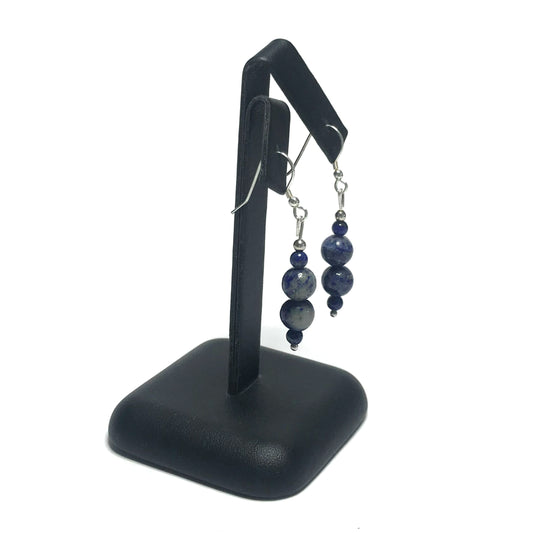
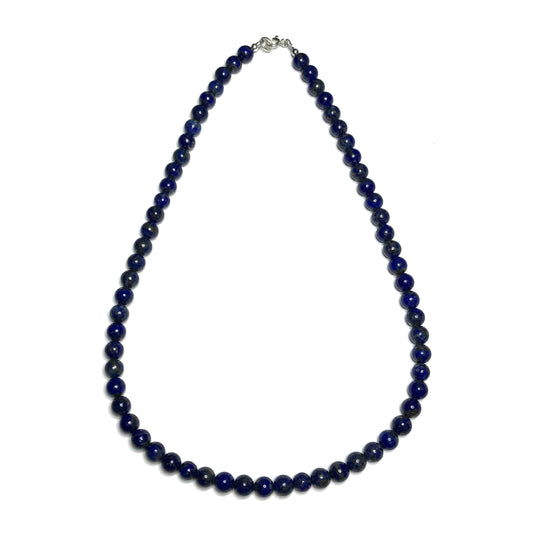
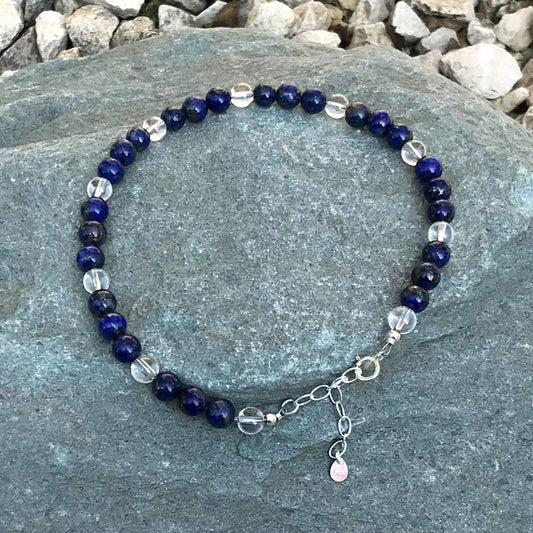
Lapis Lazuli Jewellery and Accessories
Lapis Lazuli meaning
Lapis Lazuli is associated with wisdom, truth and inner vision. It is often linked with clarity, self-awareness and spiritual insight, making it a stone that symbolises understanding, expression and higher knowledge.
Meaning and symbolism:
• Wisdom
• Truth
• Inner vision
• Clarity
• Self-awareness
• Spiritual insight
What does Lapis Lazuli look like?
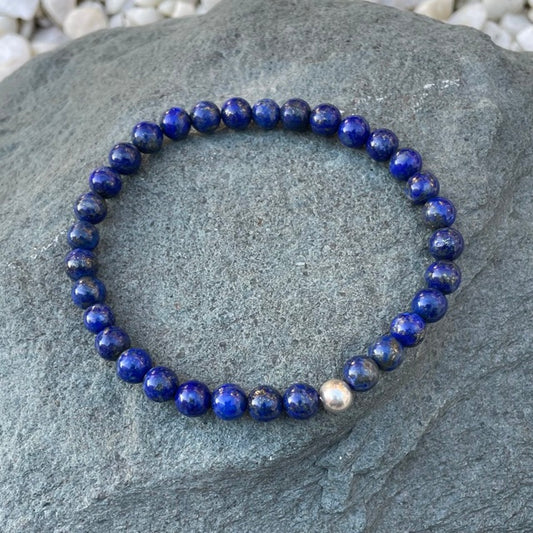
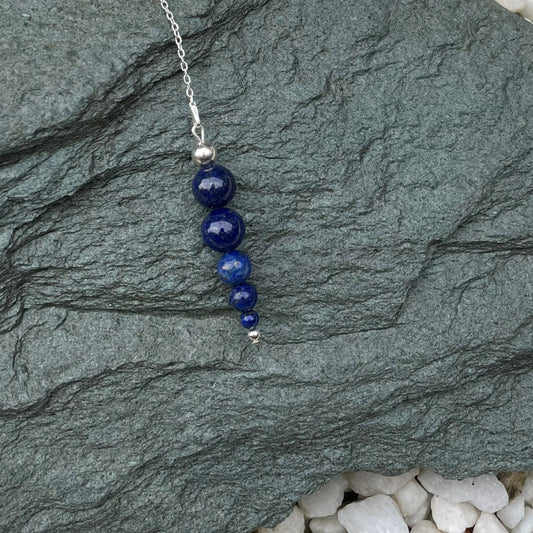
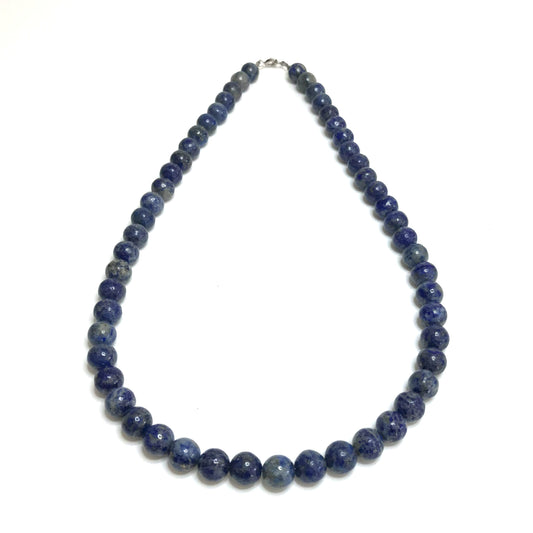
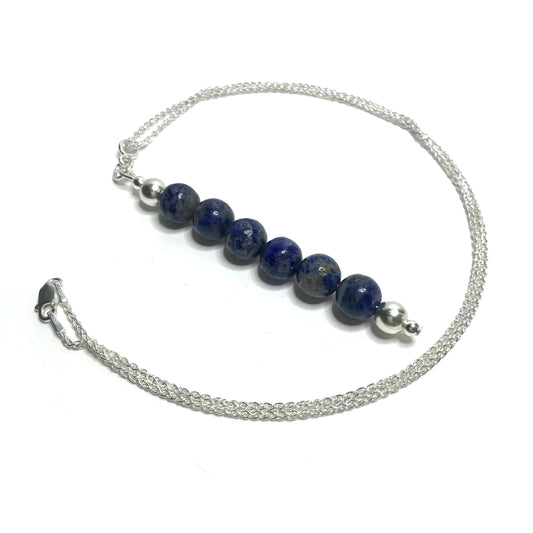
Lapis Lazuli is admired for its rich royal to deep blue colour. It often contains small flecks or veins of golden pyrite, and may also show white or pale grey calcite within the stone. Some pieces are a more even, solid blue, while others have stronger visible patterning. Its dramatic blue colour, often dotted with gold-like sparkle, is one of the main reasons it has been prized for thousands of years.

What is Lapis Lazuli used for?
Jewellery
- Beads: Lapis Lazuli is often cut into beads for necklaces, bracelets, and other jewellery pieces.
- Cabochons: It is also commonly shaped into cabochons where its rich blue colour can be shown clearly.
- Inlays: Lapis Lazuli may be used in inlay work to add deep colour and contrast to a design.
Healing
- Wisdom: In crystal healing traditions, Lapis Lazuli is often used when the aim is to support wisdom and deeper understanding.
- Communication: It is commonly chosen to encourage honest communication and self-expression.
- Inner truth: Lapis Lazuli is also used where clarity, insight, and a stronger connection to inner truth are wanted.
Spiritual practices
- Meditation: Lapis Lazuli is often used in meditation focused on insight, awareness, and deeper reflection.
- Third eye work: It may be used in spiritual practices connected with intuition and inner vision.
- Throat chakra work: Lapis Lazuli is also commonly used in practices centred on communication and speaking clearly.
Decorative
- Carvings: Lapis Lazuli has long been used for carvings such as bowls, amulets, handles, and ornamental objects.
- Decorative ornaments: It is also kept as a decorative stone because of its rich blue colour and historical association with luxury and craftsmanship.
Other
- Pigment: Lapis Lazuli is still used by some artists as a source of ultramarine pigment, although this is now a specialist use.
Cleansing and charging Lapis Lazuli
All crystals should be cleansed when you first get them and then regularly after that. They should also be charged to keep them at their full power.
Two of the most common ways to cleanse crystals is with water and with sunlight.
Can Lapis Lazuli get wet?
Lapis Lazuli can tolerate brief contact with water, but it should not be soaked or left wet for long periods. The safest way to clean it is with warm soapy water and a soft cloth, testing a small area first if the stone may have been dyed or treated. Avoid prolonged soaking, harsh chemicals, and rough cleaning.
Can Lapis Lazuli go in sunlight?
Lapis Lazuli is best kept out of prolonged direct sunlight and away from strong heat. Some treated or dyed pieces may fade over time, and heat can also affect coatings or other treatments. Brief light exposure is usually fine, but long periods in strong sun are best avoided.
For a more comprehensive guide check out this blog post: How to Cleanse and Charge Crystals
Lapis Lazuli healing properties
Physical healing properties
- Physical support: Lapis Lazuli is often associated with supporting overall wellbeing and the body’s natural balance.
- Vital systems: It is sometimes linked with supporting the immune, respiratory, and nervous systems.
- Soothing comfort: Lapis Lazuli is often used in crystal healing traditions where the focus is easing physical discomfort and encouraging greater steadiness.
- Hormonal balance: It may also be associated with support during times of hormonal change or imbalance.
Emotional and mental healing properties
- Emotional ease: Lapis Lazuli is commonly associated with easing stress, anxiety, and low mood.
- Self-expression: It is often linked with expressing thoughts, feelings, and emotions more openly and clearly.
- Confidence: Lapis Lazuli is also associated with self-confidence, inner assurance, and emotional honesty.
- Clarity: It may be used where the aim is to encourage objectivity, calm thinking, and a more balanced emotional state.
Metaphysical healing properties
- Inner truth: Lapis Lazuli is often associated with compassion, honesty, and a deeper connection to inner truth.
- Awareness and intuition: It is commonly linked with self-awareness, creativity, intuition, and spiritual development.
- Protection: Lapis Lazuli is often used in spiritual practices focused on energetic protection and blocking negative influences.
- Spiritual power: It is also associated with personal power, dreamwork, spiritual journeying, and manifestation.
Affirmations for Lapis Lazuli
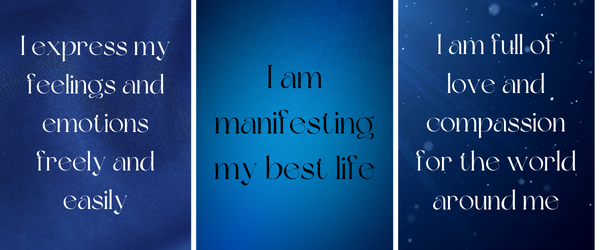
Affirmations are a great tool to use alongside crystals. They can be used to set your intention and further personalise your journey of healing and growth. Firstly, decide which of the many properties of Lapis Lazuli you feel is needed in your life at this current time. Next, write down your affirmation as if it is already happening, in the present tense. Remember your affirmation must be positive, for example rather than “I do not lie to try to get out of unwanted situations” write “I feel safe to be honest with others”.
Here are some examples you can use:
Where to place Lapis Lazuli in your home?
Lapis Lazuli can be placed in various areas of your home to enhance its positive energy and benefits. Here are some popular locations:
- Home office: Place Lapis Lazuli on your desk or near your workspace to support creativity, intuition, self-confidence, and a calmer approach to your tasks.
- Meditation space: Place it in your meditation space to support inner truth, spiritual insight, and deeper reflection.
- Living room: Place it in your living room to create a calm, thoughtful, and balanced atmosphere.
- Bedroom: Place it in your bedroom to encourage peace, clarity, and a more restful environment.
Ultimately, the best place to put Lapis Lazuli in your home is where you feel it will have the most positive impact on you. Trust your intuition and choose a location that resonates with you.
What chakra is Lapis Lazuli good for?
Lapis Lazuli is primarily associated with the third eye chakra. The third eye chakra, also known as the Ajna chakra, is located between the eyebrows, is responsible for intuition, spiritual awareness, and psychic abilities.
Because of this association, Lapis Lazuli is often used when the aim is to strengthen intuition, support inner wisdom, and see things with greater clarity and self-awareness.
In addition to the third eye chakra, Lapis Lazuli also supports the throat chakra, which is associated with communication, self-expression, and creativity.
How to use Lapis Lazuli
Lapis Lazuli can be used in an area of your house or placed within your energy field.
To be within your energy field a crystal can be:
- Placed near you
- In your pocket, wallet, purse or bag
- Worn as jewellery or an accessory
The crystal’s energy will now be working to heal, improve your life.
Another option is to meditate with Lapis Lazuli. You can either place it on one of your chakras or hold it in your hands. This is especially powerful if you have a particular healing property you wish to receive.