Countries of origin: Russia, Australia, Sweden
Hardness on Mohs scale: 5.5-6.5
Rarity: Common
Zodiac signs: Taurus, Scorpio
Chakra: Heart
Planet: Venus
Rhodonite Jewellery and Accessories
Rhodonite meaning
Rhodonite is associated with love, compassion and self-love. It is often linked with emotional healing, forgiveness and balance, making it a stone that symbolises care, harmony and gentle support.
Meaning and symbolism:
• Love
• Compassion
• Self-love
• Emotional healing
• Forgiveness
• Balance
What does Rhodonite look like?
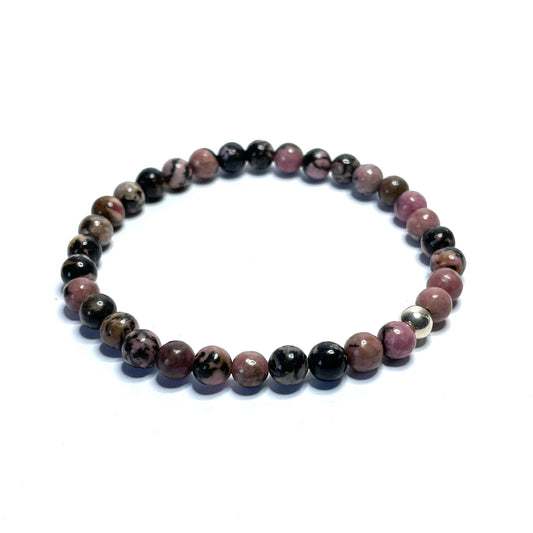
Rhodonite is typically a deep pink or rose-coloured gemstone. However, depending on the specific composition and impurities, it can also exhibit variations in colour, including shades of brown, grey, and even green. The intensity of the pink colour can vary significantly between different specimens.
One of the distinctive characteristics of Rhodonite is its black manganese oxide inclusions. These inclusions often form a pattern within the stone, giving it a unique and visually interesting appearance.
Rhodonite can have a vitreous or pearly lustre and can appear translucent or opaque. The cut and polish of the stone can also affect how the colour and inclusions are displayed.

What is Rhodonite used for?
Jewellery
- Necklaces: Rhodonite is often used in necklaces where its pink colour and dark natural patterning can be seen clearly.
- Rings: It is commonly used in rings where its distinctive colouring gives the piece more character.
- Earrings: Rhodonite can also be used in earrings to add soft colour with a more striking natural pattern.
- Accessories: It may be used in other jewellery pieces where its unusual appearance is the main feature.
Healing
- Emotional healing: In crystal healing traditions, Rhodonite is often used when the aim is to support emotional healing and recovery.
- Balance: It is commonly chosen to encourage emotional balance and a steadier state of mind.
- Compassion: Rhodonite is also used where forgiveness, understanding, and a gentler emotional energy are wanted.
Decorative
- Display pieces: Rhodonite is often kept as a decorative stone because of its pink colour and contrasting markings.
- Carvings and ornaments: It can also be used in decorative objects such as carvings, sculptures, and other display pieces.
Cleansing and charging Rhodonite
All crystals should be cleansed when you first get them and then regularly after that. They should also be charged to keep them at their full power.
Two of the most common ways to cleanse crystals is with water and with sunlight.
Can Rhodonite get wet?
Yes, Rhodonite can get wet. It is a relatively durable gemstone and can withstand exposure to water. However, like other gemstones, it is best to avoid prolonged soaking or exposure to harsh chemicals, as these can damage the stone's lustre or colour.
If you have a Rhodonite jewellery piece, you can clean it gently with warm water and a soft cloth. Avoid using abrasive cleaning agents or ultrasonic cleaners, as these can scratch or damage the stone.
Can Rhodonite go in sunlight?
Yes, Rhodonite can go in sunlight. However, prolonged exposure to intense sunlight can cause the stone's colours to fade over time. If you're concerned about preserving the vibrant colour of your Rhodonite, it's best to store it in a dark place or use a protective case when not wearing it.
For a more comprehensive guide check out this blog post: How to Cleanse and Charge Crystals
Rhodonite healing properties
Physical healing properties
- Insect bites: Rhodonite is thought to help with relieving insect bites.
- Scarring: It is thought to help reduce scarring.
- Bone growth: Rhodonite is believed to assist with bone growth.
- Arthritis: It can ease inflammation of joints and arthritis.
Emotional and mental healing properties
- Reduces stress and anxiety: Rhodonite is thought to help calm the mind and ease feelings of stress and anxiety.
- Promotes self-love and acceptance: It can encourage individuals to embrace their true selves and develop a positive self-image.
- Heals emotional wounds: Rhodonite is believed to aid in the healing of emotional wounds and trauma.
- Fosters compassion and forgiveness: It can help individuals cultivate compassion and forgiveness for themselves and others.
- Enhances emotional balance: Rhodonite is said to promote emotional balance and stability.
- Improves focus and concentration: Rhodonite is thought to enhance mental clarity and focus.
- Stimulates creativity: It can help spark creativity and inspire new ideas.
- Boosts self-esteem: Rhodonite is believed to boost self-esteem and confidence.
- Reduces negative thoughts: It can help alleviate negative thoughts and self-doubt.
- Promotes emotional intelligence: Rhodonite is said to enhance emotional intelligence and understanding.
Metaphysical healing properties
- Chakra balancing: Rhodonite is thought to balance the heart chakra, which is associated with love and compassion.
- Spiritual growth: Some believe that Rhodonite can support spiritual growth and development.
- Love and compassion: Rhodonite is often associated with unconditional love, compassion, and empathy. It can help to heal emotional wounds and foster harmonious relationships.
- Self-love: This gemstone is believed to nurture self-love and acceptance. It can help individuals to overcome feelings of self-doubt and embrace their unique qualities.
- Grounding and balancing: It is believed to ground and balance the energy centres of the body, promoting harmony and stability.
- Creativity: Rhodonite is often associated with creativity and inspiration, helping to unlock one's artistic potential.
Affirmations for Rhodonite
Affirmations are a great tool to use alongside crystals. They can be used to set your intention and further personalise your journey of healing and growth. Firstly, decide which of the many properties of Rhodonite you feel is needed in your life at this current time. Next, write down your affirmation as if it is already happening, in the present tense. Remember your affirmation must be positive, for example rather than "I wish I could love myself" instead say "I love myself".
Here are some examples you can use:

Where to place Rhodonite in your home?
Rhodonite is often used to promote emotional healing, self-love, and stress relief. Given these qualities, here are some popular locations to place Rhodonite in your home:
- Bedroom: Near your bed to foster restful sleep and emotional balance.
- Living room: On a coffee table or shelf to create a calming atmosphere and encourage positive energy flow.
- Meditation or yoga space: To enhance your spiritual practice and emotional connection.
- Home office: To reduce stress and improve focus.
- Kitchen: To promote harmony and abundance.
Remember, the best location for your Rhodonite is where you feel it resonates most with you personally. Trust your intuition and experiment with different placements to find what works best.
What chakra is Rhodonite good for?
Rhodonite is primarily associated with the heart chakra. The heart chakra, also known as the Anahata chakra, is located in the centre of the chest and is connected to love, compassion, and emotional healing.
Because of this association, Rhodonite is often used when the aim is to support emotional healing, encourage compassion, and bring greater balance to the heart.
How to use Rhodonite
Rhodonite can be used in an area of your house or placed within your energy field.
To be within your energy field a crystal can be:
- Placed near you
- In your pocket, wallet, purse or bag
- Worn as jewellery or an accessory
The crystal’s energy will now be working to heal, improve your life.
Another option is to meditate with Rhodonite. You can either place it on one of your chakras or hold it in your hands. This is especially powerful if you have a particular healing property you wish to receive.